Why Veganism is False
It isn't always immoral to kill animals to eat their meat.

Let’s cut to the chase:
It appears that we are designed to kill animals to eat their meat.
If it appears that we are designed to Φ, it is not always immoral to Φ.
(Conclusion, From 1 + 2) It is not always immoral to kill animals to eat their meat.
Defence of Premise 1
Many aspects of human biology suggest that we are designed to eat meat, alongside other foods1. One example is human teeth. Your canines appear designed to tear through flesh. Another example is your digestive tract, which is shorter than a herbivore’s and longer than a carnivore’s, reflecting an omnivorous diet. Your gut produces all the necessary enzymes to digest meats. Some nutrients are incredibly hard to find naturally except in meats. And, frankly, meat is delicious. If we were not meant to eat meat, we could expect it to be disgusting to us (or at least not delicious) like many things we shouldn’t eat are.
The Roadkill Objection
Objection: What you have said doesn’t show that Premise 1 is true! Premise 1 said that we are designed to kill animals to eat their meat, while the evidence so far merely shows that we are designed to eat meat. What it doesn’t show is that we are designed to kill the animals. Perhaps our biology is designed so that we can find roadkill and animals that have died of old age to eat.
Response: Eating roadkill or animals that have died of natural causes doesn’t appear to be part of the design. Firstly, such meat is often unhygienic, having rotted in ways that would prevent a human from consuming it without risking disease. Animals that die of natural causes obviously do not receive the same treatment that slaughtered animals do, and they therefore are less appropriate for eating. Secondly, humans that ate only meat of this kind would only very rarely find meat that they could eat, and so the digestive system’s readiness for decent quantities of meat does not accord with the theory that we were designed only to eat roadkill or relevantly similar meats. Thirdly, humans are clearly designed to hunt as well as to eat: we have eyes set in the front of our heads, rather than the sides, allowing for binocular vision, a feature that many predators share and prey do not. We are able to run and walk extremely long distances, which is terrific for hunting. We are also able to track animals effectively and use tools to hunt them. These last two points are not very strong evidence of design for hunting, as they are arguably just results of our ability to reason (rather than being capabilities specifically designed for hunting), but nonetheless they may be convincing points to some.

The Genesis 9 Objection
Objection: Christians shouldn’t think we are designed to kill animals for meat. It was only in Genesis 9:3, as part of the Noahide Covenant, that humans were given meats to eat:
Everything that lives and moves about will be food for you. Just as I gave you the green plants, I now give you everything. - Genesis 9:3 (NIV)
Therefore, before this covenant, humans ate only plants, so they can’t have been designed to kill animals for meat.
Response: Humans are designed to feel pain and grief, but, according to many traditional views, before the Fall there was no physical harm to elicit pain or death to elicit grief. Therefore, it is evident that on Christianity, God’s design reaches beyond the initial stages of the world, and anticipates later developments. Thus, the fact that the very first humans didn’t do certain things doesn’t mean we are not designed to do those things. It appears that God anticipated the Noahide Covenant by designing humans to eat meat even if they didn’t do so until the Noahide Covenant.

Defence of Premise 2
I find this premise intuitive, and my hope is that it will be accepted by people regardless of their philosophical stripes. However, I recognise that it is a lot more believable to theists than it is to atheists. This is because a theist will see human design as the result of a moral agent who seeks the good, and so is unlikely to create humans designed to do something immoral.
The Skeptical Theism Objection
Objection: Adam, you are a skeptical theist, as you have shown in other posts on Substack. This means you believe that you don’t know what reasons God might have for allowing certain evils. You therefore should be willing to accept the possibility that God might design something in a way that is in fact immoral. Thus, it’s possible that God could have designed humans to kill animals for their meat, despite it being immoral to do so.
Response: You’re right, I am a skeptical theist. Luckily for many of my readers, they may not be, and so this objection doesn’t work against them. Nonetheless, I have a response available to skeptical theists: firstly, as clarified in this post, my skeptical theism is not the view that we can’t know what reasons God might have for allowing certain evils, but is instead the view that we can’t come to know about those reasons via noseeum inferences: we can’t reasonably argue ‘I don’t see the reasons, so they ain’t there!’
Objection: So, what?
Response: Well, we can still know via other methods of inference that God wouldn’t allow certain evils. In this case, it seems we can know that God didn’t allow this evil - the evil of immoral design - because God explicitly allows the consumption of meat (in Genesis 9:3 above). God saying that He will allow you to do something is as good as a confirmation from God that doing that thing is not immoral2.
The Aliens Objection
Objection: Some wasps are designed to burrow into human eyes and lay their eggs there. Premise 2 would establish that such behaviour is morally permissible.
Response: Non-human animals are not (usually) moral agents, so actually their behaviour is always morally permissible.
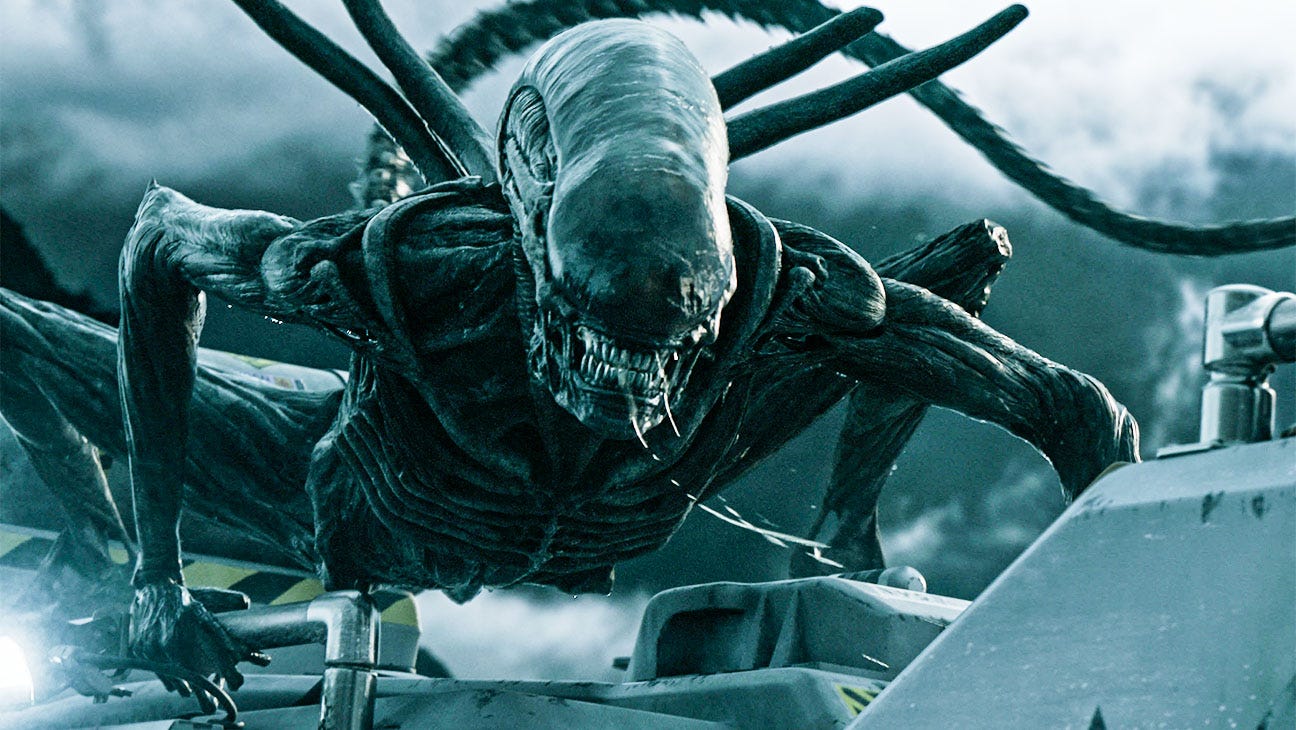
Objection: Okay, but we can imagine aliens that are moral agents and behave in a similar way, like the aliens in Aliens. Surely it is not moral for them to kill humans in order to reproduce? It seems, then, that Premise 2 is false.
© 2017 Twentieth Century Fox Film Corporation. All Rights Reserved.
Response: Premise 2 uses the term ‘we’. Unless my readership happens to include aliens, the use of the term ‘we’ is limited to human beings, so the premise does not apply to those aliens. Therefore, the example does not show Premise 2 to be false.
Objection: That’s just gerrymandering! The point is that a similar premise should apply to aliens who are moral agents if it is a genuine moral fact. So, is it moral for these aliens to reproduce in the way they do?
Response: This is a problem for many ethical views, not one unique to Premise 2. For example, virtue ethicists who ground ethics in human flourishing are subject to a similar attack, because it seems that alien flourishing involves killing humans. There are a couple responses that virtue ethicists give, one of which might work here: we can say that it is not just gerrymandering to apply the principle only to humans, because human morality is not inter-species - it applies only to humans and to try to apply it to aliens is a category mistake. This will not be convincing to everybody, especially those with a realist bent, because many of us have the intuition that if something is immoral, it is immoral for any moral agent, regardless of species.
However, we don’t need to take this virtue ethical approach. Instead, we can point out that Premise 2 initially got a lot of support from theism, and theism also points us to a response to the Aliens Objection. The idea here is that God would not create a universe containing such aliens, because God would not design moral agents to do something immoral. This is one of the reasons we believed Premise 2 in the first place, so it is not an ad hoc response to the Aliens Objection.
Thus, it appears to me that the Aliens Objection should only persuade you if you are an atheist moral realist and not a virtue ethicist.
The Subjectivity Objection
Objection: Whether or not something appears to be the case is subjective! Thus, somebody could employ Premise 2 to justify pretty much anything to themselves. For example, they might say that it appears to be the case that we are designed to murder people and thus, by Premise 2, that it is not always immoral to murder. It clearly is always wrong to murder, so Premise 2 must be false.
Response: The sense in which I use the word ‘appears’ is not one which is subjective. In the sense I am using, one must present evidence which suggests a certain conclusion about design. There being evidence of this kind is what it means for it to ‘appear’ to be the case that we are designed for something.
Objection: Then why use the word ‘appears’? Why not just say ‘If we are designed to Φ, it is not always immoral to Φ.’ and give your evidence for that premise?
Response: The sentence you suggest is only acceptable to somebody who believes human beings genuinely were designed. Somebody who doubts intelligent design would not be able to accept such a premise. By using the word ‘appears’, the argument encourages assent from anybody who thinks that evolution gives rise to features that appear like design, but are not actually designed.
This argument would not work if skeptical theism were to undermine belief in divine testimony. As promised in the aforementioned article on skeptical theism, I am planning to write an article which shows that skeptical theism does not do this.
So I think premise 2 is probably false. If we did some research and it turned out that human penises were designed to rape, that shouldn't make us think that rape is sometimes ok. (Actually, iirc there is some theory that the penis head is designed to scoop out other's sperm, so who knows).
But either way we can grant the argument and still accept ethical veganism, since we probably aren't designed to farm animals on factory farms, and veganism is generally only concerned with ordinary circumstances.
Isn't it clear that we were shaped by evolution and meat eating simply improved our survival chances? This does not depend on what god wants but what the environment demands. It doesn't seem to be the case that evolution itself has a moral teleology, other than that collaboration is often beneficial